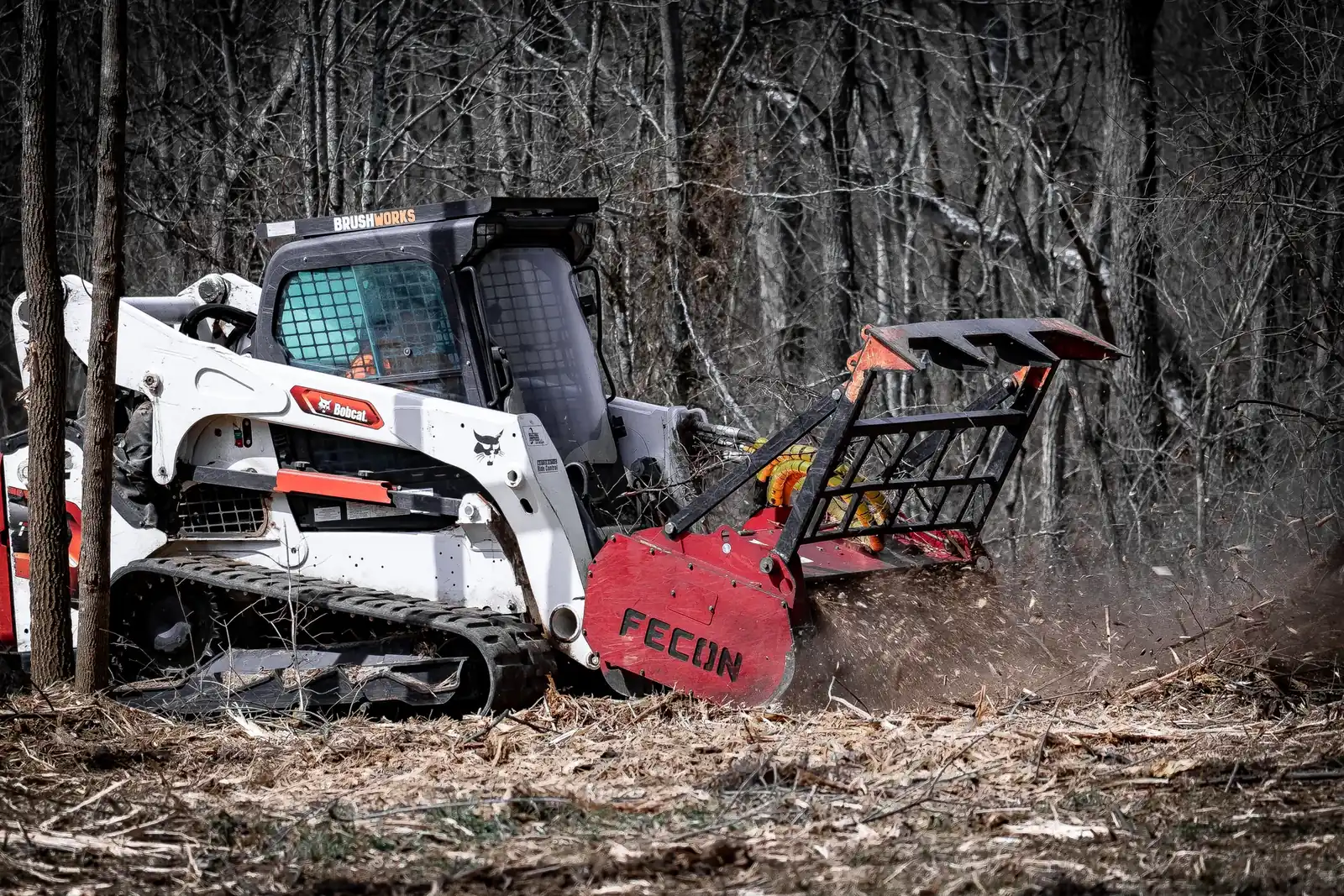
Fields and pastures open again: Brush Hogging in Rutherfordton, NC
Pasture, hay ground and open fields mowed back to usable ground; we clear brush and weeds up to two inches thick across Rutherford, Polk, Cleveland and McDowell counties.
Land clearing from $1,500 for the first visit. The final price depends on acreage, terrain and access; any return visit is quoted separately.
The Fast, Affordable Way to Clear Overgrown Land
Brush hogging, also called bush hogging, is rotary cutting for overgrown fields, pastures, and open ground carrying grass, weeds, and light brush up to 2" in diameter. It is the cost-effective option when a property needs mowing rather than heavy-duty forestry mulching.
People search for this work under both names. Bush Hog is a brand of rotary cutter that became the common term for the equipment, so "bush hogging" and "brush hogging" describe the same service. Either way, the machine and the result are identical.
Brush Masters provides professional brush hogging services for properties that need regular maintenance or initial clearing before more intensive work.
Our rotary mowers cut through tall grass, weeds, small saplings, and light brush quickly and efficiently. This is the right tool for pasture reclamation, overgrown property cleanup, maintaining previously cleared land, and lot clearing ahead of development.
Brush Hogging Around the Foothills
Open-field work is mostly farm ground. See pasture reclamation in Shelby, land clearing in Bostic and land clearing in Mooresboro, or land clearing in Columbus for Polk County horse farms.
The brush removal cost calculator prices a field by acreage, density and terrain.
Brush Hogging Service Area
We serve a 50-mile radius around Rutherfordton, NC across five counties. If you're inside this circle we can usually be on-site within a week.
Rutherford County, NC
- Rutherfordton land clearing 0 mi
- Spindale land clearing 2 mi
- Forest City land clearing 4 mi
- Bostic land clearing 7 mi
- Henrietta 10 mi
- Caroleen 10 mi
- Ellenboro land clearing 11 mi
- Lake Lure land clearing 13 mi
- Chimney Rock land clearing 12 mi
- Union Mills land clearing 9 mi
- Cliffside land clearing 14 mi
Polk County, NC
- Mill Spring 11 mi
- Columbus land clearing 15 mi
- Tryon land clearing 19 mi
- Saluda land clearing 24 mi
Cleveland County, NC
- Mooresboro land clearing 16 mi
- Lattimore 18 mi
- Boiling Springs 22 mi
- Shelby land clearing 23 mi
Henderson County, NC
- Bat Cave 16 mi
- Edneyville 21 mi
- Hendersonville land clearing 29 mi
McDowell County, NC
- Marion land clearing 20 mi
- Old Fort 22 mi
Cherokee County, SC
- Gaffney land clearing 27 mi
Not sure if your address is in range? Call (828) 532-3671 or email us. Radius-based coverage means a few zip codes outside the circle still work if the route makes sense.
How Brush Hogging Works
Fast, affordable clearing for overgrown land
Site Assessment
We evaluate the vegetation type, obstacles, and terrain
Rotary Mowing
Our powerful brush hog cuts through grass, weeds, and light brush
Clean Results
Your land is cleared, accessible, and ready for use or maintenance
Brush Hogging vs. Forestry Mulching
Which service is right for your property?
Brush Hogging
- Grass, weeds, and brush up to 2" diameter
- More affordable per acre
- Great for ongoing maintenance
- Leaves stubble (regrowth possible)
Forestry Mulching
- Trees, brush, and vegetation of all sizes
- Cuts above-ground growth; roots may remain
- Creates beneficial mulch layer
- Long-lasting results, minimal regrowth
Not sure which service you need? We'll help you choose during your free site assessment.
Contact us for a consultation →Curious what this service costs on your land? Use our Instant Pricing Tool for a customized estimate based on acreage and terrain.
Calculate My PriceRelated Services
Explore our other professional land clearing services in North Carolina
Brush Hogging FAQ
Direct answers about pricing, equipment, service area, and process.
Brush hogging in the Rutherfordton area typically runs $80, $150 per hour or $200, $500 per acre for standard pasture and field work. Heavy brush, saplings, and overgrown lots that haven't been cut in 2+ years run toward the per-acre top end.
Brush hogging uses a rotary cutter on the back of a tractor, it cuts grass, weeds, and small saplings up to about 2 inches and leaves them on the ground in pieces. Forestry mulching uses a much heavier cutting head that grinds woody material up to 14 inches into a fine mulch. Brush hog is right for fields and pastures; mulching is right for woods and dense brush.
Pastures, hay fields, food plots, right-of-ways, vacant lots, fence rows, ditch lines, easements, and overgrown yards. We routinely take down 4 to 6 ft tall weeds, blackberry briars, saplings under 2 inches, and seasonal growth.
A 50-mile radius from Rutherfordton. Rutherford, Polk, Cleveland, Henderson, and McDowell counties, including all the farmland around Mill Spring, Columbus, Mooresboro, Lattimore, Shelby, and Marion.
Most fields and pastures benefit from 1 to 2 cuts per year, once in late spring to set the season back and once in late summer to keep saplings from establishing. Hay fields and food plots may only need an annual end-of-season cut.
We bring 5 to 8 ft rotary cutters depending on access and field size. Wider cutters make short work of large open fields; narrower cutters fit through gates and tight turns around tree lines and structures.
Late spring (May. June) and late summer through early fall (August. October) are the prime windows. We avoid the heart of nesting season where possible, and we don't hog soft, saturated ground because it damages the field.
Ready to Clear Your Land?
Our team is standing by to assess your property and provide a fixed-price quote.